Cookie Consent for SaaS: How to Choose the Right Approach for Your Website
A practical framework for evaluating cookie consent tools based on your website, technology stack, privacy requirements, and governance needs.

.svg)
The right consent solution is the one that matches your organization’s technology, privacy requirements, and operating needs.

Many SaaS teams start with the same question: “Do we have a cookie banner?”
But the more useful question is: What does our organization actually need its consent setup to do?
For some companies, a straightforward consent banner integrated into an existing marketing platform may be entirely appropriate. For others, a flexible Webflow-native implementation may be the better fit. Organizations with more complex privacy, reporting, or governance requirements may choose a dedicated Consent Management Platform (CMP).
There is no single solution that is right for every organization.
The goal of this article is to help SaaS teams understand the different approaches available and the questions they should consider when deciding what is appropriate for their website, technology stack, and privacy requirements.
Note: Zabal Media is a web design, development, and performance marketing agency, not a law firm. Privacy and consent requirements vary by organization, jurisdiction, technology stack, and legal interpretation. Companies should work with qualified legal or privacy professionals to determine their specific obligations. Product functionality also changes over time, so current vendor documentation should always be reviewed when making implementation decisions.
Start With Your Requirements
Cookie consent involves more than the visual banner a visitor sees.
Depending on your organization, important considerations may include:
- Granular consent categories such as analytics, marketing, and functional technologies
- How non-essential cookies and scripts behave before and after a visitor makes a consent choice
- Regional or jurisdiction-specific consent experiences
- Integration with analytics, advertising, CRM, and marketing technologies
- How and where visitor preferences are stored
- Whether consent information needs to be retained beyond the browser
- Whether timestamps or historical consent information are needed
- Policy or consent-language versioning
- Reporting or audit requirements
- Control over third-party scripts
- Management across multiple websites or digital properties
- The amount of customization your website team requires
Not every organization needs every capability.
A smaller SaaS company with a relatively straightforward website and marketing stack may have very different requirements from an enterprise organization operating across multiple regions with dedicated privacy, security, and legal teams.
That distinction should guide the technology decision.
Approach 1: HubSpot Cookie Consent
For organizations already using HubSpot extensively, HubSpot's native cookie consent functionality can provide a convenient way to manage visitor preferences within an existing marketing ecosystem.
Where HubSpot Can Be a Good Fit
HubSpot may be particularly useful for teams that:
- Already operate much of their marketing stack through HubSpot
- Want consent functionality that integrates naturally with HubSpot tracking
- Need visitors to manage different consent categories
- Want regional consent configuration
- Prefer to minimize the number of separate platforms their marketing team needs to manage
HubSpot stores a visitor's consent state and exposes consent information through its JavaScript API. Those preferences can then influence HubSpot-owned cookies and tracking behavior.
For teams whose website and marketing technology are heavily centered around HubSpot, that native integration can be valuable.
Implementation Considerations
Many SaaS websites use technologies beyond a single marketing platform.
A typical website may also include Google Tag Manager, analytics platforms, advertising pixels, chat products, personalization tools, embedded applications, and custom scripts.
When evaluating HubSpot's consent functionality, teams should therefore consider how consent preferences interact with their entire technology stack.
Organizations with broader reporting, historical consent, or privacy-governance requirements may also need to evaluate whether additional infrastructure is appropriate.
That does not make HubSpot the wrong solution.
It simply means the implementation should be evaluated against the organization's actual requirements.
Relevant HubSpot Cookie Consent Documentation
- Cookie banner setup & behavior: https://knowledge.hubspot.com/privacy-and-consent/set-up-a-consent-banner-with-the-new-editor
- Cookie banner JavaScript API: https://developers.hubspot.com/docs/api/events/cookie-banner
Approach 2: Finsweet Cookie Consent for Webflow
For companies building and managing their websites in Webflow, implementation flexibility and control over the website experience can be especially important.
Finsweet provides a Webflow-focused approach to cookie consent that can be a strong fit for teams that want their consent experience to integrate closely with the rest of their website.
Where Finsweet Can Be a Good Fit
Finsweet may be particularly useful for teams that:
- Build and manage their marketing website in Webflow
- Want significant control over the design of their consent experience
- Prefer a lightweight implementation
- Want granular visitor preference controls
- Have Webflow or front-end development resources available
- Want consent functionality that fits naturally into their existing website workflow
For design-focused SaaS companies, this flexibility can be valuable.
A consent interface is still part of the website experience, and some teams prefer to have more control over how that interaction looks and behaves.
Understanding the Implementation Model
Different consent solutions store and manage visitor preferences differently.
Finsweet's core Cookie Consent implementation can store visitor consent preferences in browser cookies. Those preferences can then be used to determine how technologies behave based on the visitor's selections.
For many website implementations, browser-based preferences may be appropriate for what the organization is trying to accomplish.
Other organizations may have requirements that extend beyond the browser.
For example, a company may want to connect consent information with internal infrastructure, retain information separately, or create additional reporting and governance processes.
Those are architectural requirements rather than a simple question of whether one product is better than another.
When those needs exist, teams should determine whether they want to extend their implementation, build supporting infrastructure, or use an additional privacy-management platform.
Finsweet Consent Pro and More Advanced Implementations
Finsweet also provides Consent Pro for teams that want to extend consent information beyond a basic browser implementation.
According to its documentation, consent data can be sent to a server-side endpoint, allowing organizations to connect that information with broader infrastructure if their requirements call for it.
For teams considering a more advanced implementation, useful questions include:
- Where should consent information live?
- How long should it be retained?
- Does it need to connect with other internal systems?
- Who needs access to it?
- What reporting does the organization need?
- Who will maintain the supporting infrastructure?
- What requirements have been established by the organization's legal or privacy team?
For some organizations, the flexibility of this approach may be exactly what they need.
For others, broader privacy-management requirements may make a dedicated CMP a better operational fit.
Relevant Finsweet Documentation
- Cookie Consent overview: https://finsweet.com/cookie-consent
- How it works: https://finsweet.com/cookie-consent/learn/how-does-finsweet-cookie-consent-for-webflow-work
- Consent Pro documentation: https://consentpro.com/docs/how-to-store-consents
Approach 3: A Dedicated Consent Management Platform
As organizations grow, consent management can become less about the banner itself and more about broader privacy operations.
A company may operate multiple websites, serve users across multiple jurisdictions, manage a large marketing technology stack, or have dedicated legal, security, and privacy teams with more extensive requirements.
In those situations, organizations may decide to evaluate a dedicated Consent Management Platform.
Dedicated CMPs are generally designed to centralize more of the consent and privacy-management process within a specialized platform.
Depending on the provider, organizations may evaluate capabilities such as:
- Centralized consent management
- Historical consent information
- Regional configuration
- Policy management
- Reporting and audit functionality
- Administration across multiple websites or properties
- Third-party technology management
- Broader privacy-management workflows
- Support and privacy resources
There are a number of providers in this category, each with different approaches, integrations, pricing models, and capabilities.
Where Osano Can Fit
Osano is one dedicated CMP that Zabal has experience implementing for clients.
Its platform is designed to support broader consent and privacy-management requirements beyond the visual website banner itself.
For organizations evaluating Osano, or any dedicated CMP, the important question should still be whether the platform matches the organization's requirements.
Considerations may include:
- Regional and jurisdictional requirements
- Consent record management
- Reporting needs
- Administrative controls
- Integration with the existing technology stack
- Implementation complexity
- Ongoing ownership
- Support requirements
- Pricing
- Contractual terms
- The organization's broader privacy program
Osano also provides privacy and compliance resources and offers additional commercial protections under certain terms.
Organizations interested in those offerings should review Osano's current documentation and contractual terms directly with their own legal or privacy advisors.
Relevant Osano resources include:
- Global privacy and cookie consent information
- Privacy and compliance resources
- Privacy management platform information
- Osano's No Fines, No Penalties Pledge
These Approaches Solve Different Needs
It can be tempting to place consent products into a feature comparison and simply ask which one has the most capabilities.
But that can lead teams toward the wrong decision.
A company operating primarily within HubSpot may reasonably prioritize native integration and simplicity.
A Webflow team may prioritize design flexibility, development control, and an implementation that fits naturally within its existing workflow.
An organization with broader privacy-management requirements may prioritize centralized governance and decide to use a dedicated CMP.
Those are different sets of requirements.
All can be reasonable.
The most sophisticated solution is not automatically the best solution.
It is only valuable if the organization actually needs the additional sophistication.
Cookie Consent Is Also a Website Architecture Decision
Consent management does not exist in isolation.
It can affect analytics, attribution, advertising, experimentation, personalization, marketing automation, and how third-party technologies are loaded across the website.
That is why the decision should involve more than one team.
Marketing should understand how the implementation may affect campaign measurement.
Analytics teams should understand how visitor preferences interact with data collection.
Developers should understand how scripts and technologies are loaded.
Legal and privacy teams should establish the organization's requirements.
Website teams should consider the visitor experience and ongoing maintenance.
When these groups work together, the organization is more likely to choose an approach that works both technically and operationally.
Questions to Ask Before Choosing a Consent Solution
Before choosing a platform, start with the requirements.
Ask:
- What technologies currently run on our website?
- Which technologies need to respond to visitor consent preferences?
- Which countries or regions do we serve?
- What requirements have been established by our legal or privacy advisors?
- Do we need consent information to persist beyond the browser?
- Do we need historical consent records?
- Do we need centralized reporting or audit capabilities?
- Do we operate one website or multiple digital properties?
- How frequently does our technology stack change?
- Who will own the consent implementation internally?
- How much customization does our website team need?
- How much ongoing maintenance are we prepared to manage?
The answers to those questions should guide the technology decision.
Not the other way around.
Choosing the Right Consent Approach
For some SaaS companies, consent functionality within an existing platform such as HubSpot may be the most practical choice.
For others, a flexible Webflow-focused solution such as Finsweet may provide the right combination of control, customization, and simplicity.
Organizations with broader privacy, governance, reporting, or operational requirements may choose to evaluate dedicated CMPs, including platforms such as Osano.
None of those decisions should begin with the assumption that one approach is universally superior.
They should begin with the organization's requirements.
The goal is not to choose the most sophisticated consent platform available.
The goal is to choose the right consent approach for your organization.
For existing Zabal clients, please reach out to your project manager if you would like help reviewing your current consent implementation and website technology stack.
Prospective clients can contact us to discuss website architecture, analytics, consent implementation, and broader digital infrastructure.
Share this article
Zabal Journal
Related Content

Webflow Enterprise Compliance Playbook: 7 Steps to Sustainable Governance, QA, and Accessibility
Discover how Zabal Media builds Webflow Enterprise websites that scale with trust, governance, and measurable quality.

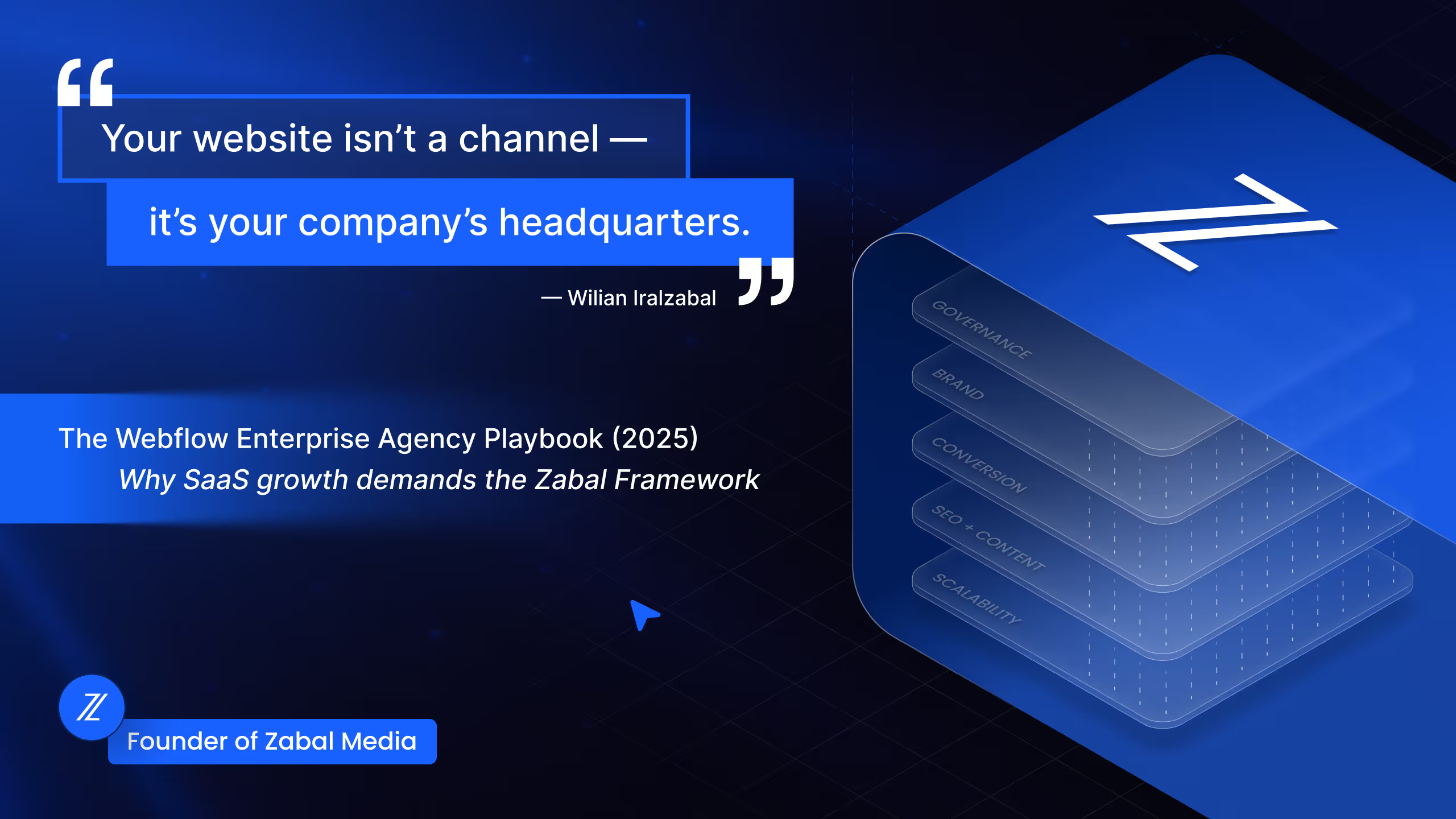
Webflow Enterprise Agency Playbook (2025) | Why SaaS Growth Demands the Zabal Framework
Zabal Media reveals its 5-Layer Webflow Enterprise Framework for SaaS leaders. Learn why most websites fail and how to transform yours into a true growth engine.

SEO vs. AEO: What’s Changing in the Age of AI Search
Discover the differences between SEO and AEO, why AI is changing search, and how SaaS and enterprise brands can future-proof visibility with Answer Engine Optimization.